Thursday, 21 August 2025

Another milestone for the forthcoming book: #FeesMustFall - Ten Years On

In 2025-26 we commemorate the ten-year anniversary of the South African student movement of 2015-16, known by campaigns, campus movements and formations like #FeesMustFall, #EndOutsourcing, #RhodesMustFall, #OpenStellenbosch, #PatriarchyMustFall, #RUReferenceList. 


Starting from the end of 2015, a project started to create a number of archives on the movement, and in 2022 Dr Anye Nyamnjoh and I initiated a project specifically to provide a platform for a critical reflection on the history, significance, and legacy of the South African student movement. This started in 2023 with a national colloquium on the movement (see blog entry here). After this, a proposal and call for papers was developed for a book with an editorial team that included a broad spectrum of scholar-activists from different backgrounds. 

Now this process is gradually coming to a close. The Mandela University Press received the full manuscript of the book a month ago - and the book is now under review. Of course, the editors and the many authors and co-author teams are excitedly waiting for the outcome of the review and the process of publishing this important book to continue. 

If all goes well, the first book launches will be held before the end of the year and continue throughout 2026 - across South Africa and possibly also in major African, Global South and Global North centres of activism, higher education, and engaged scholarship. We are excited!

Friday, 1 August 2025

Rethinking higher education: Public and private synergies for student success in Africa


The July 2025 issue of the Journal of Student Affairs in Africa arrives at a pivotal time in the discussions around higher education and student success in South Africa and on the continent. It comes also in the context of almost seismic global disruptions (and we are thinking here of AI, geo-political madness and climate change-related conflicts, combined with the ongoing structural challenges within African post-school education systems. This compels us to ask hard but essential questions: What kind of higher education systems do we need to serve our students and our societies better? And critically, can we afford to ignore the growing role of private higher education in that future?

The JSAA feature article is feathered by Ahmed Bawa and Linda Meyer, ‘Becoming more private: Broadening the base of South African higher education’. It courageously interrogates the long-standing public-private divide in the South African higher education sector and explores how declining government funding, siloed and ill-articulated institutions, and systemic socio-political inequality make the emboldened participation of private higher education not only viable but inevitable. A truly functional and future-oriented system must enable coordination, collaboration, and shared responsibility between all HE actors, public and private alike, toward a unified national learning agenda (and extending this into all Africa).

The rest of the issue builds on this theme of rethinking structures and support for student success across African higher education. There are articles on a health and wellness intervention programme; peer mentoring; the role of residence advisors in student academic success; on first-year student belonging; on counselling; on student activism, climate action and other student extracurricular activities and on managing an extended orientation programme in the context of COVID-19. The book review by Dr Sibeso Lisulo, reflects on Widening university access and participation in the Global South: Using the Zambian context to inform other developing countries by Edward Mboyonga. According to Lisulo, the book offers both case-based insights and transferable strategies for inclusion and equity that higher education leaders across the continent would do well to consider. 

As this issue illustrates, student success is not merely a matter of programme design, it is a systemic concern. This invites us to examine the assumptions, architectures, and power dynamics that shape our institutions. Whether we are talking about health, belonging, leadership, activism, or orientation, we must look not just at what we do within universities, but how our systems are organised, and how public and private actors can align for the broader public good. This alignment will necessarily raise questions about purpose, equity, access, and what kind of higher education architecture we need for a just and thriving Africa.

Rethinking higher education in Africa thus requires us to think across several levels or units of analysis – from the micro, individual level of student experience and student success, to support for different groups of students and rethinking the roles of residences, for example, in the academic and social engagement of students. It includes the meso level of institutional diversity and complementarity, and at the macro level, the purpose of higher education in Africa. We started this editorial with reference to the growing polarisation we see in the world – from “geopolitical madness” to conflicts around migration and increasing climate-change-related conflicts. Universities in Africa have to create transformative leaders (with the values, knowledges, attitudes, skills and networks) to respond to the fast-changing context and create peaceful, prosperous and equitable societies. Contributing to this as student affairs professionals, scholars and researchers, gives meaning to our work. And if our institutions fail to deliver on the promise of freedom, peace and prosperity, then they might as well be trade schools.

Birgit, Thierry and Teboho

This is a shortened version of the latest editorial in JSAA. The full editorial can be found at:

Schreiber, B., Luescher, T. M., & Moja, T. (2025). Rethinking higher education: Public and private synergies for student success in Africa. Journal of Student Affairs in Africa, 13(1), v–vii. DOI: 10.24085/jsaa.v13i1.6227 


Monday, 28 April 2025

Reimagining the African University of the future - Thought-leader interviews

Mark Paterson and I just concluded a series of over 40 brief articles in University World News Africa based on interviews with African higher education thought-leaders. The articles highlight key ideas and innovative practices in African higher education that anticipate the 'future African university' today. They engage with current debates in African higher education such as the growing place and use of African languages in higher education (as against colonial languages); African indigenous knowledge systems and epistemologies; curricular reforms and changes in the delivery of higher education; the impact of massification on a range of matters like university funding, student and staff complements, infrastructure, diversity of institutions and differentiation; and the increasing emphasis on 'tertiary TVET', professional training and practical skills, and so forth. 

The thought-leaders were carefully chosen to include a wide range of scholars, professionals, youth leaders, and grant-makers that are deeply and reflectively involved in the development of universities across the continent. They include: 

Goolam Mohamedbhai, Mogobe Ramose, Reitumetse Mabokela, Rekgotsofetse Chikane, Dzul Razak, Catherine Odora Hoppers, Neil Turok, Adam Habib, Madeleine Arnot, Paul Zeleza, Tade Aina, Lihle Ngcobozi, Rajesh Tandon, Claudia Frittelli, Peter Materu, Birgit Schreiber, William Mpofu, Saleem Badat, Sabelo Ndlovu-Gatsheni, Laura Czerniewicz, Issa Shivji, Nelson Masanche Nkhoma, Cheryl de la Rey, Doyin Atewologun, Tshilidzi Marwala, Ndungu Kahihu, Patrício Langa, Teboho Moja, Chris Bradford, Fred Swaniker, Shanen Ganapathee, Ernest Aryeetey, Yunus Ballim, Achille Mbembe, David Awuah, Thoko Mayekiso, and Fikile Vilakazi. 

In the choice of this illustrious group of thought-leaders, the project team of The Imprint of Education (TIE) project of the Human Sciences Research Council took care to try and balance the views by adding selection criteria (other than the ones above) to also ensure gender, age, region, and broad expertise. In addition to the UWN articles, some of the (edited and approved) transcripts of the interviews are also published on the TIE website. Maybe I should mention that it wasn't only I who did interviews but a whole range of TIE project collaborators, including: Catherine Odora Hoppers, Ibrahim Oanda, Relebohile Moletsane, David Everatt, Crain Soudien, James Otieno Jowi, Sharlene Swartz, Krish Chetty, Alude Mahali, Angelique Wildschut and Vuyiswa Mathambo.

After the conclusion of the series, the second big step now is the publication of the book "Rupture and innovation in the African university", which I co-authored over the last 16 months with Vuyiswa Mathambo, Angelique Wildschut and Crain Soudien. It is due to be published by AISA Press (the Africa Institute of South Africa Press), which is an imprint of the HSRC Press. We hope it will also be co-published with CODESRIA Press which would then be the leading house for the French version of the book. 


Friday, 18 April 2025

Creating a sustainable diamond open access future for African scholarly journals

 The Journal of Student Affairs in Africa (JSAA), of which I am a founder and editorial executive, has received a substantial development grant to support its decadelong history as diamond open access journal into the future. 

The grant-maker is EIFL (Electronic Information for Libraries), which is a not-for-profit organisation based in Vilnius, Lithuania, that works with libraries and journals to enable access to knowledge in developing and transition economy countries in Africa, Asia Pacific, Europe and Latin America. JSAA shares EIFL's vision of "a world in which all people have the knowledge they need to achieve their full potential". 

EIFL has provided JSAA with funding to hold its first ever in-person full editorial team workshop; build capacity and tools (such as an editorial manual and a financial sustainability plan); renew its editorial team and operationalise the community of practice in student affairs research that JSAA launched in 2022. The  grant-holder is JSAA's long-term project partner and publisher, African Minds.

In March 2025, the JSAA editors held an editorial summit and workshop in the historic town of Porto (Portugal). The venue was chosen among several options (Zanzibar, Mauritius, South Africa, Morocco and Portugal) because it turned out to be more accessible and less costly for the editors who come from South Africa, Germany, USA, Ethiopia, and the UK. Nonetheless, parts of the workshop was held hybrid to enable a full participation including editors, who for various reasons were not able to join in person (several last-minute).

The five-day editorial summit/workshop focused on (1) discussing the financial sustainability plan; (2) discussing the operationalisation of (a) the community of practice and (b) the JSAA awards; (3)  discussing the renewal of the editorial board and international editorial advisory board; and (4) developing a draft operational manual for JSAA. In addition and somewhat unexpectedly, the three Editorial Executives present in person at the summit also developed (5) a new concept paper on ways to enhance JSAA's contribution to the professionalisation of student affairs with extensive capacity building work. This, they included in their Yidan Prize application. As part of the context: On the encouragement of some of the most outstanding higher education and student affairs scholars and professionals world-wide and particularly in Africa, Prof Moja, Prof Schreiber and I have applied for the educational development prize given annually by the Yidan Prize committee.

The draft operational manual that the summit produced includes a detailed outline of the procedures, some automated and some manual involved in producing JSAA. This Operational Manual will be the guide to review and renew the JSAA website and serve as training tool and reference manual for new and existing section editors, editorial executives, and journal managers. Once complete, the operational Manual will include sections on:

1. Manuscript Submission Management
2. Editorial Review and Assignment
3. Peer Review Coordination
4. Decision Making
5. Manuscript Revision Management
6. Copy Editing
7. Formatting and Layout
8. Proofreading
10. Marketing and Promotion
11. Ethical Oversight, Plagiarism and AI
12. Administrative Tasks
13. Quality Control, and Improvement
14. Mentorship 

This will be drawing on, and update, the present author guidelines for submission and publishing, but dealing with it from the perspective of editors of the journal. 


Friday, 31 January 2025

New issue published: JSAA 12(2): Advancing Student Success

This is the second guest-edited issue in partnership with the South African Association of Senior Student Affairs Professionals (SAASSAP), led by guest editors Drs Neo Pule, Irene Mohasoa,  and  Prof.  Matete  Madiba.  

The  title  of  this  issue,  ‘Advancing  Student  Success  in  Higher  Education  through  the  Scholarship  of  Integration’, emphasises the importance of scholarship. For student affairs scholarship  in  Africa to be  successful  we  require  a  conducive  ecosystem  that  advances knowledge creation and facilitates the publishing process. Many factors within and beyond academe enable or hinder knowledge production. 

Enjoy the read! Thierry

Thursday, 19 December 2024

Advancing Critical University Studies in Africa - Methodology Academy: Learning 'World Cafe'

The Advancing Critical University Studies (ACUS) Africa Conference is an annual inter-institutional conference and training event. This year it was structured as a conference incorporating a methodology academy for emerging scholars in critical university studies with add-on workshop-based training in a participatory and emancipatory methodology (World Cafe). 

Overall, the intended learning outcome was to strengthen the critical and theoretical thinking of (emerging and early career researcher) EECR  participants about African higher education and universities in Africa. Researchers and academics from the Human Sciences Research Council (HSRC), University of Venda, Nelson Mandela University, and Makerere University, conceived and facilitated an EECR World Café research methods academy that ran in conjunction with the ACUS Africa Conference with the outcome to give participants a thorough conceptual, methodological and practical introduction to the World Café methodology. 

For the HSRC, participation was conceived primarily in terms of the training academy for emerging African scholars working on higher education. 

Participation in the World Café EECRA ran as part of the conference sessions which HSRC participants and other participants were a part of and attendance of the academy required an additional sign-up and commitment. Thus, the methodology academy ran specifically for the African EECR attending, in addition to the theoretical and thematic conference papers and discussion. Attendance was entirely free of charge, and for the first time, it was conducted in hybrid format (online and offline).

From the HSRC EEE in particular, the programme included the following panelllists: 

  • Prof. Thierry Luescher and Dr Keamogetse Morwe co-facilitated the academy workshops in which over 140 EECR participated both online and in-place
  • Leya Mgebisa and Zimingonaphakade Sigenu co-facilitated in place the World Café research methodology and hosted feedback sessions during the course of the workshop
  • Zimingonaphakade Sigenu presented a paper on the isiXhosa intellectual archive and insights for contemporary African universities

The broader make-up of participants comprised around 150 emerging and early career researchers from Makerere University, specifically those who are completing their Masters and PhD studies in the East African School of Higher Education Studies and Development as well as early career and emerging scholars from a number of institutions in Ghana, Botswana, Kenya, Nigeria, Tanzania, and South Africa. 

The participation was characterised by active engagements both in-place and on-site with the emerging scholars participating in a practical exercise of the World Café methodology with some of them being table hosts (data collectors) and study participants addressing the questions, "What are some of the persistent inequities and challenges that universities in Africa face in becoming Afrocentric universities?" and "What practical steps can we pursue towards creating an Afrocentric university?"

Like in previous years, the Academy was particularly problem and project-oriented, with a practical component of actually participating in the design and operation of a research project using World Cafe. 

The participation also included the participants actively reflecting and feeding back on the methodology and experience of practically implementing it as well as carving out ways in which the methodology can be used for decolonial and emancipatory research and ways to incorporate indigenous practices within the methodology to make it better suited for the African context.

The Academy ran from 16 to 18 October 2024. 

Friday, 29 November 2024

The four-dimensional professor

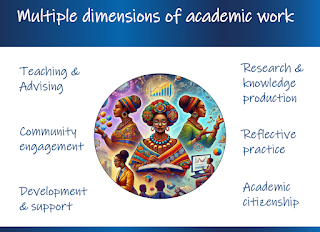
 In a complex and changing academic context, early career academics must be aware of the many dimensions that academic work involves. In whatever discipline or field you are building your career, there are global challenges that cannot be ignored, alongside global efforts to address these challenges, such as the UN SDGs. We are in the midst of the threat of climate change wreaking havoc across the Global South, and just survived one of the most deadly global pandemics in human history; there are massive technological advancement and an incisive digital transformation underway with AI offering huge opportunities as well as challenges and threats. In the midst of this, academic work must provide equitable quality education and contribute to deep societal transformation, especially in post-colonial and post-conflict societies in the Global South. In short: we need a new generation of academics who can provide transformative leadership across the multiple functions of academic work; academic game-changers.

What are those dimensions?


Among the top-of-mind academic work functions are:

  • Teaching & Advising
  • Community engagement
  • Development & support
  • Research & knowledge production
  • Reflective practice
  • Academic citizenship
In the dimension of research, knowledge production and reflective practice (and its interrelation with community engagement, as well as teaching, advising and academic citizenship,) developing an identity as researcher-academic is becoming increasingly important. My argument is that the conception of the 'teacher-academic' of previous centuries has given way to that of the 'researcher-academic' in the last fifty years or so, increasingly ubiquitously, not anymore in the exception of the 'star research professor' but it is the new normal.

In this new normal, the 'researcher-academic' is a professor who takes the leap into the 'fourth dimension' - leading in knowledge creation, policy influence, partnerships, transformation and sustainability. 


This transformation of the academic work and the workplace, there are naturally tensions. In the 'fourth dimension' - determining knowledge production - the three-dimensional professor of old becomes a digitally-enhanced, natural and artificial intelligence-connected, multiverse being; but tensions abound. I have not even reflected on many of them related to the digital and AI connection yet, but rather on some of the 'old' vs. 'new' tensions, like at the very basic level, of taking the leap from scholar to researcher; tensions between type 1 and type 2 knowledges; collaboration (with other human and machine colleagues) or working in the hermetically, and so forth.


The fourth dimension is also the one where dreams become reality in ways that a 20th century steel and mortar generation still feels hard to grapple with; the creation of international consortia, policy laboratories, global research studios, and so forth, has become cost-neutral. The most precious resource remains time (money has always been a distraction)! 

And like MS and others have long discovered, the true value is not in owning the application, but developing and maintaining the platform. Hence, a key issue - undervalued but of paramount importance - is to be in the centre of the knowledge process as owner and editor of knowledge platforms, like scholarly journals.

I'll leave this here; many of these thoughts are ready for building up, critiquing, developing. I'll love to hear from you. 

(A detailed version of this discourse was delivered by me as keynote at the Research Indaba, Tshwane University of Technology, Pretoria, 11 October 2024.)