Saturday, 23 November 2013

Blue, Red or Green? South Africa's Differentiated University System

Blue, Red or Green?
South Africa's Differentiated University System
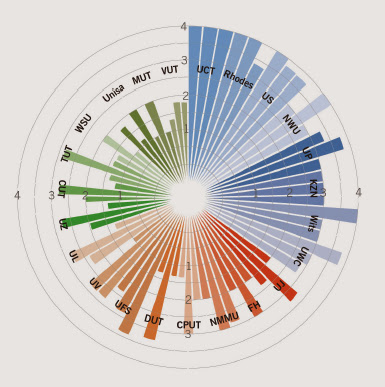
On the basis of knowledge input and output indicators, CHET has developed an empirical model differentiation in South Africa's university system.

The blue institutions, which include the University of the Western Cape (UWC), are the most knowledge (and research) intensive, while red and green institutions score in the middle and lower ranges on indicators of academic staff input, undergraduate to masters output and high-level knowledge output.

For details see CHET on differentiation.

Friday, 22 November 2013

World Bank’s Africa Initiative: Forgetting the Faculty | Inside Higher Ed

World Bank’s Africa Initiative: Forgetting the Faculty | Inside Higher Ed
The World Bank has announced a “Centers of Excellence” initiative that will provide $158 million to a select group of African universities  “to strengthen the capacity of selected universities and their partner institutions to deliver high quality training and applied research at the regional level” in the words of the project document as reported in University World News (November 3, 2013). Some 15 universities will be selected to receive up to $8 million each to strengthen the institutions. One missing key element will absolutely doom the project to failure. No funding will be provided to the academics teaching at the universities although there will be money to bring in short-term people and consultants. What this means is that the key personnel who are responsible .....
Read more: http://www.insidehighered.com/blogs/world-view/world-bank%E2%80%99s-africa-initiative-forgetting-faculty#ixzz2lN6zTdQk
Inside Higher Ed 

Monday, 11 November 2013

Wits produces most employable graduates

Wits is having it all :) 
For once, Wits has stolen the lime light from UCT and comes out tops on all scores.
Well done. Thierry

Wits produces most employable graduates

Issued by: Wits University, Johannesburg, 11 November 2013

Wits University is the only African university chosen by top international recruiters to be ranked in the Global Employability University Ranking, which was published in the New York Times recently.
The Global Employability University Ranking is a list of the top universities as selected by more than 5 000 recruiters, including CEOs and chairpersons, from top companies in 30 countries, who were asked to rank universities based on the employability of their graduates. Each had 10 votes to cast and could also add additional universities. Wits came in at 139 on the list.

Ever wondered which universities produce the most millionaires?
Wits is also ranked 57th in the world for producing the most number of alumni millionaires, according to a study compiled for Spear's Magazine. Wits came in ahead of the University of Colorado (58), Brown University (63), the London Business School (64), Stanford Business School (68), Monash University in Australia (74), and the University of Cape Town (80).
The study also lists which subjects produced the most millionaires, with engineering coming first, followed by an MBA, economics and law – although according to Spear's, millionaires produced by these subjects have often left their degrees behind in professional life.
This follows on the Times Higher Education ranking of universities that produce the most number of CEOs. Titled the THE Alma Mater Index: Global Executives, the ranking puts Wits at 24 in the world (it lists the top 100), placed above prestigious institutions such as New York University, Korea University, the University of Stuttgart, and Texas A&M University, to name a few.
Wits is the highest ranked African institution on the list. The University of Cape Town, the only other African university on the list, came in at number 79.
"It is gratifying to know that as a university at the heart of the national and continental economy, Wits continues to provide the world with a growing cohort of world-class African CEOs," says Professor Adam Habib, Wits Vice-Chancellor and Principal.
The Global Employability University Ranking forms part of the Global Employability Survey, an online survey conducted in 20 countries worldwide, with the objective of describing the ideal university from a corporate perspective.
One of the trends picked up by the Global Employability University Ranking is the breakthrough of a number of Chinese universities (five noted, with two in the top 50), while universities from other Asian countries make their first appearance: three from Hong Kong, two from Singapore, and two from South Korea. India went from one to three universities, with a very strong performance from the Indian Institute of Science.
Another new trend is the phenomenon known as MOOCs (Massive Open Online Courses), which are online programmes made available by universities. The recruiters who were surveyed said they felt certain this new form of higher education would have a great impact on the economic model of universities, since it was bound to reduce a university's financial burden